Showing posts with label science. Show all posts

Tuesday, 5 November 2024


  Post Hoc Exilium (after this exile). A line from a very early Christian hymn, Robert MacFarlane talks, in his book 'The Wild Places', of monks who chose to live on remote Scottish Islands building tiny cells and living in harsh conditions in order to be closer to God. They felt that they were in exile from heaven.


In a remote Cornish bay in the idyll of my childhood I would stand in the clear water and try to touch the ferny seaweeds that floated there. Their texture was beautiful but I could not touch it, I was of the earth and air, they of the water. I could only try and touch them with my mind.


 In 2016 I began a residency with the vascular surgery unit at St.Mary's hospital in Paddington London (see the Thread Management blog in the side menu). Whilst working there with Professor Colin Bicknell I could not touch I could only look but I saw him train a young surgeon by allowing her to put her hand on his as he felt his way through to where he needed to be. 


Between the seaside holiday and now I have learned many techniques with textiles, the most obvious involve touch, the less obvious are about sight and visual texture.


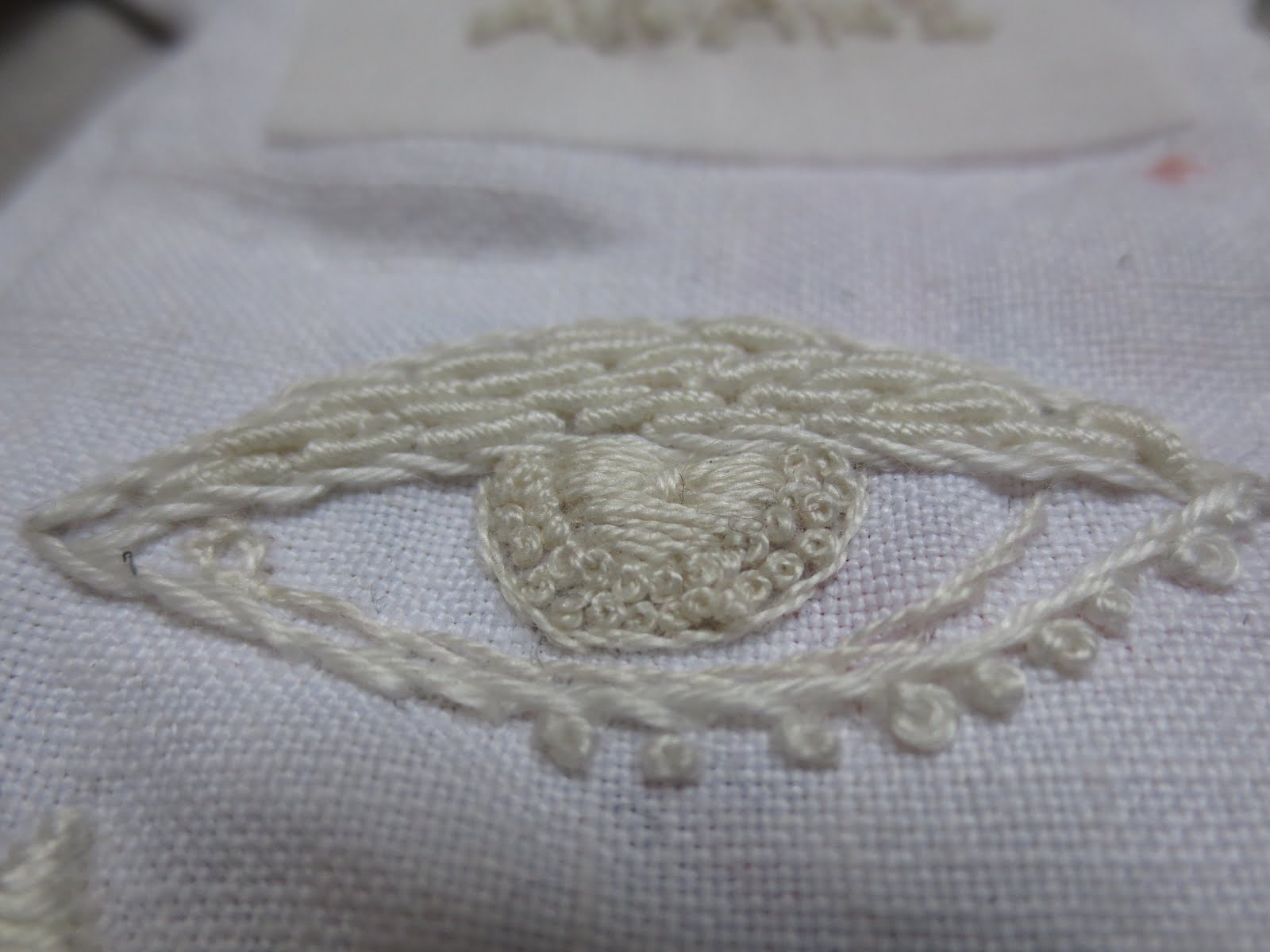
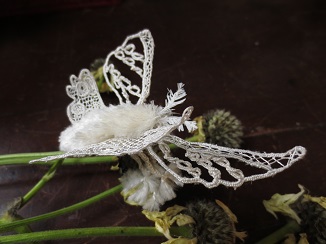
The piece that you see here represents all that I know of my craft mapped onto what I know of the surgeons. 


The vascular system of the hand is made using the needlelace cordonnet technique, the glove has seams which mirror those arteries. Both pieces have cuffs, one in a sturdy reticella style lace with branching arterial pattern, the other is a freestyle needlelace.


I took particular care to retain the 3D quality of the arteries where the deep palmer arch seperates from the superficial palmer arch.


 Though there is the obvious parallel between our knowledge what it also speaks of is the extension of touch that I already understood and the extension of empathy that I had to make to understand the world of surgery.  

Monday, 6 June 2022

SomeBody


   As a rule I don't generally put my medical work on this blog as I don't want to scare off the unwary! However it has been taking up a lot of headspace and so rather than neglect things over here I will share some technical details from my most recent piece for Imperial College, 'SomeBody'.

  The work here is from a medical model which is being performed for young people in an anti knife crime initiative.The basis for the visuals is as ever historical and contemporary textile techniques used as metaphors for the anatomy.

  Buttonholes become stab wounds, rouleaux loops become blood vessels, 18th century frills are muscles, silk purses become digestive organs and origami becomes heart and lungs.


  There is a series over on the Thread Management blog (linked in the side bar) featuring it in more detail.


Thursday, 2 September 2021

Spare Parts


 Paul Craddock has just published his book "Spare Parts: A Surprising History of Transplants". His extensive research into the history of the techniques of surgery found us both examining antique embroideries at the V&A museum and later led to filming me stitching cigarette paper. 

This post shows that film    

In the film clip above Paul discusses what is was all about.

and now you can buy the book!


Wednesday, 19 February 2020

Surgery and embroidery

Fleur's Cube from Paul William Craddock on Vimeo.

 I have previously described some of what I have been doing on this piece , 'The Epiploic Cube', but now you can see it doing its thing......
 It was made in response to watching not just surgery for three years but the surgeons hands; how they move and respond to their 'materials'. It is not something that just anyone is allowed to watch and certainly not something that many would want to. However it is so fascinating that I felt I had to try and give people an idea.
 In June of 2019 I wrote a coupe of posts describing the process of designing and embroidering the cube and although there is already a lot of it over on 'Thread Management' here are a few images of the completed piece.


A trimming I made inspired by the tassels for Caselguidi embroidery in the 'Wordsworth Country' range of silks from The Silk Mill


A bud in detached buttonhole stitch on taffeta,  all woven silks were from ' The Silk Route'

 
One of the embroidered and elasticated straps which hinder the movement of the cube,


 A collapsing cube made in organza with an embroidered dorset button inside. If folds up and tucks into a pocket on one face of the cube but has to be removed before you can 'operate'.


  The side of the cube that surgeons don't like, it turned out that the colour has a dark significance for them. The embroidery is incomplete because I then went on to distress the fabric, repair it and distress it again.


Plans and notes for each side, I like to make a shade card for each piece of work that I do.

 
In the background here you can see a copy of Therese de Dillmont's Encyclopedia of Needlework! 1886 (a link to the Gutenburg Project online copy)


Friday, 14 June 2019

The Slashed Doublet


  I have always been drawn to Tudor costume and the slashed patterns in the fabric. Some years ago I went to an exhibition of costume at the Queens' Gallery and there was a beautiful little jacket with bound edged slashes all edged with french knots.The level of detail was extraordinary and I squirreled it away in my mind for another time! Five years later the opportunity arose to have a go and so I tried to put as much detail into my little panel as in that doublet. The panel is part of a piece of work made for my medical residency where I have created objects to draw parallels between the worlds of textiles and surgery.

 For this panel I layered organza over taffeta to create a shot effect. There were three smaller panels which formed the final square and each piece was hand bound, gathered, slashed and embroidered. The panels were then laced together with silk ribbon tipped with silver aiguillettes.


Monday, 10 June 2019

Lots to tell


  It is very rare that I talk about the medical work on this blog for fear or frightening people away ! but I can share some details of my new piece with you now as it's all about embroidery and colour. I have created a folding cube toy which has nine embroidered or raised surfaces inspired by costume detail. It illustrates how surgeons understand some of the body by using conceptual space, if you need to know more then click here for my medical blog. I will devote a few posts to this beginning here with some 18thC trimming techniques.
 Above we have a tiny length of passementerie known as fly fringe. I was looking at this on a dress at the V&A museum and have discovered that they were made by people who lived and worked near the silk weavers. They often worked together to provide matching trimmings for a customer as each length of silk was made in very small quantities. The button makers would be nearby too and I love to think of these creative and skilled communities working together, albeit probably unappreciated by the client!


  There is a pocket flap on this panel so it required a button. I made a covered bead as I often do for my stumpwork pieces and looked for some buttonhole inspiration. I settled on a couched buttonhole with metal thread set back slightly from a bound edged.
  The book I used for most of this piece was the V&A's 'Historical Fashion in Detail, the 17th and 18th Century', now in another format.

Thursday, 28 February 2019

So long at the fair


   I haven't forgotten this blog, it's just that everything is being made but nothing finished! Did I mention the wasps nest that I'm making or the tiny box of stones or the lace...…….
Well, here is a sneak peek at something much more mysterious, others will appear on the 'other' blog soon.

Thursday, 19 April 2018

Imperial Festival


 As you may know I am one of the artists in residence with Imperial College London working mainly with the vascular surgery unit. On the weekend of the 28th April I will be taking part in their annual festival where the public are allowed in to see what happens in the college.

                                         http://www.imperial.ac.uk/festival/

  The work that I have done called 'The Textile Body' will be there on show to discuss and explore with the public.
  I also talk about this piece and my experience as an embroiderer working with surgeons on this blog,

                                         http://threadmanagement.blogspot.co.uk/

and I assure you it is suitable for the squeamish !!!! and it is the fact that it is not squirmy that we will be demonstrating  in the Queens Tower rooms at the South Kensington campus near the Victoria and Albert museum.

Please come and say hello!

Tuesday, 27 February 2018

Vein charm


  The third in my series of modern charms, the vein charm. I have copied a bifurcated vascular stent in silk organza and thread with enamelled wire and gold plated beads. These are in fact made by hand for surgeons in Mexico by workrooms of women stitching by hand using gortex and suturing thread:the gold is so that it can be clearly positioned under x-ray.
  I began reading the Kalevala a few years ago and was struck by how many charms were used during the saga.These are generally poems or songs requesting help from the natural world and one was particularly fascinating; the hero's mother has to reassemble her son(!) and sings him back together, at one point singing a vein charm.Remarkable in itself but more so the level of anatomical knowledge in the song !
 Mine was not easy, a case of wrong tools and wrong materials but nevertheless I produced this little number (3x8cm).

Sunday, 8 October 2017

here there and everywhere


 In case you're wondering where I have been don't forget to read  Museum for Objects of Vertu  and  Thread Management too!!

Saturday, 30 September 2017

Tate Exchange


   Next Saturday afternoon, 7th October,at Tate Modern I will be talking with Roger Kneebone and Rachael Matthews about the worlds of textiles and surgery and what we are learning from each other.
   It is part of  Tate Exchange (link here)  and our talks are curated by the artist in residence Claire Twomey. Her 'Factory, the seen and the unseen' will be on level 5 of the new Blavatnik building and we will be in the adjoining Southwark room. The talks begin at 2pm and we are on at 4.45pm
 .

Sunday, 7 August 2016

Artist in Residence


 What I didn't know about vascular surgery was that the techniques were all learnt from Belgian lacemakers in the early 20th C.; before then limbs could not be saved. I have written about my involvement with surgeons from Imperial College London over the past couple of years and the interaction of craftspeople with science and medicine. That has now moved on a tad with me being made artist in residence at Imperial's vascular surgery department! I will be working with student and practising surgeons looking at what I do and vice versa to see if there can be some 'reciprocal illumination'.
 There is a seperate blog for this work now, (over on the side bar) Thread Management

Friday, 29 April 2016

The Craft of Medicine


Another event ! I shall be demonstrating and talking with the public at an all day free event at the
Wellcome collection on Saturday May 14th

Wednesday, 13 April 2016

more thinking hands


...........a short film by J.P.Flintoff about the event on Saturday.( I appear towards the end)

Sunday, 10 April 2016

Thinking with your hands

image of my threads by Charles Saumarez Smith
  Yesterday I took part in an event at the Art Workers' Guild in London which focused on the 'reciprocal illumination' that can be had between skilled craftspeople and surgeons.It was a big event as all the invited guests were from major institutions or studios either from the arts ,science and education. We demonstrated our work and compared how it is that we work in such a similar way and yet on very different things.Discussions were held between ourselves and those we had invited  so that we could all share and get an understanding of how important hand skills are to humans and our society.
    If you are reading this you probably share our dismay at the decline of craft skills and the slow dismantling of our arts education. (petition link to stop this)We talked about how important the zen state of mind is when working and how making objects for ourselves connects us to the world around us.Some talked about 'intelligence of touch'and 'thinking with your fingers'  whilst others discussed the idea that  previous knowledge of sewing can enhance a surgeons initial learning.The mind was a common subject and although some are uncomfortable with talking about an inner self most would agree that the ability to concentrate and mental discipline were a form of 'mind yoga'.
   I'm sure that the discussions are still going on and this can only be a good thing.(the first review here) If you would like to join in too there is a public event coming up soon, please see my previous post.

Friday, 1 April 2016

The Craft of Medicine


The Craft of Medicine at The Art Workers’ Guild

What do magic and medicine have in common?
How can understanding puppetry skills change how doctors learn?
What skills do a lace-maker and a surgeon share?
( that would be me)

Come and find out as we explore the mastery of skill-learning
in medicine and the arts, and the overlaps between
different craft specialities and healthcare.

Join us for any, or all, of our series of discussion evenings:
Monday 29th of February: Magic & Medicine
Tuesday 22nd of March: Puppetry &Medicine
Tuesday 26th of April: Threads &Medicine

Registration and refreshments from 18.30
Discussion from 19.00 until 21.00 (including a short break)

All events will be at the Art Workers’ Guild, 6 Queen Square, London WC1N 3AT
Nearest tube stations Russell Square or Holborn

Places are free but limited, and must be reserved.
Please RSVP to laura.coates11@imperial.ac.uk

Friday, 18 March 2016

Diabetic lace...done !


5.Normal ER

   As previously mentioned I've just exhibited a series of needlelace panels depicting cell change in diabetes. In total there are six circular pieces mounted in an old gramophone record album. Each is worked in a lovely crimson silk from Gloriana.
  It was clear from the start that I wouldn't be making a traditional piece of lace so I decided on anarchy as my main technique ! Loose tension in the backround,completely floating cordonnets,some things which don't have names and lots of picots. Each piece took about 7-8 hours from couching through to releasing from the pad. (photo of no.6 on its' way)

1.Normal mitochondria


2.Mitochondrial destruction


3.Normal insulin containing granules


4.Electron dense glycogen particles

Tuesday, 18 November 2014

Thread Management Deja Vu


 A bit of a problem with the last post about this film so here it is again, all shipshape! It is a lovely little film about the work I have been doing with Professor Roger Kneebone and his team and documents what happens when surgeons talk to lacemakers, embroiderers, knitters, puppeteers, fly fishermen and computer modellers. The film is by Smart Docs .

( if you can't see it here, see it here !)

Thursday, 1 May 2014

Snip


   Imagine you had to sew like this ! I had a go last Saturday and it isn't easy, especially as I was sewing real skin....well pig bowel to be precise. I was part of a an interactive discussion with a group of surgeons and craftspeople brought together by Professor Roger Kneebone.(see previous post). We talked needles, one-handed knots, stitching in the round and what the body smells like inside....not a lot apparently. Embroiderers and surgeons face common technique challenges and some not so common, my material is not slippery and alive and they don't have to worry about what their sewing  looks like. 
   When sewing in a circle either on a hoop stand or attaching a cornea we all have to struggle to turn ourselves and not the 'work'.Some of our needles are the same..'leather' needles are also 'cutting' needles and we all use squissors. Your insides are often stitched with two slip knots and an overhand knot to secure which gives flexibility to a join .I may request a faggot stitch in future !!!

Thursday, 17 April 2014

The Intelligence of Touch


On Saturday 26th April I will be taking part in a surgical simulation !  This is the work of Professor Roger Kneebone( surgical educator and Brother of the Art Worker's Guild) who will bring his pop-up operating theatre to the hall of the Guild. There will be discussion on how we think with our hands with a stone carver, tailor, knitter and me amongst others from a wide range of craft and art disciplines. Medical and academic types will also be there to discuss how we understand materials and techniques with our hands and not words.
Free Entry but you must have a ticket ( apply to Monica@artworkersguild.org or call 020-77130966)
Saturday 26th April 2-4pm.
The Art Workers Guild,
6 Queen Square WC13AT

(image of 'Pi' in progress, search the science labels for more!)

LinkWithin

Related Posts Plugin for WordPress, Blogger...